
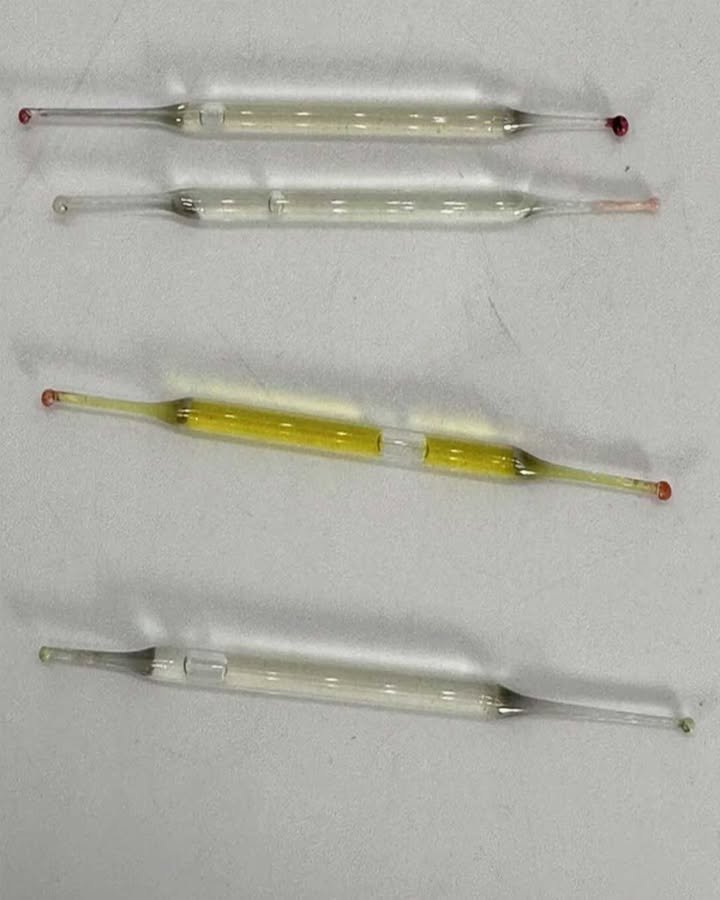
You’re renovating an older bathroom when you discover something unexpected beneath the cabinet: small glass tubes, roughly 5 cm long, each containing liquid.
At first glance, they might look like miniature bottles or laboratory samples.
So what could they be?
The truth is that their appearance alone isn’t enough to identify them safely. Small glass tubes have been used for many different purposes over the years, particularly in older homes.
Could They Be Old Medical Ampoules?
One possibility is that the tubes are glass ampoules.
Ampoules are sealed glass containers traditionally used to store medications, chemical solutions, and other substances. Older pharmaceutical products were commonly packaged this way.
If the tubes have:
- A narrow neck
- A sealed or break-off top
- Printed markings
- A colored ring or stripe
- A pharmaceutical name or number
they may be old medical or laboratory containers.
However, don’t assume the liquid is medicine just because the container resembles an ampoule.
Could They Be Laboratory Vials?
Another possibility is that they were used for laboratory, testing, or chemical purposes.
Small glass containers are convenient for storing tiny quantities of liquids, so their presence doesn’t necessarily mean they were related to the bathroom itself.
The history of the property matters. A previous occupant may have stored something completely unrelated to the current use of the room.
Could They Be Cosmetic Products?
Older cosmetics, fragrances, treatments, and personal-care products were sometimes packaged in small glass containers.
If the tubes have recognizable branding, decorative markings, or labels, they may provide an important clue.
But if the liquid is unidentified, don’t apply it to your skin or attempt to determine what it is by smelling it.
The Location Is a Clue—but Not Proof
Finding the tubes under a bathroom cabinet naturally makes people assume they were connected to plumbing, cleaning, or personal care.
That’s possible—but objects can also be left behind during previous renovations or simply forgotten by an earlier occupant.
The most useful clues are usually:
The markings + the shape of the glass + the type of closure + the appearance of the liquid + the age of the property.
What You Should NOT Do
If you discover unidentified liquid-filled glass containers during renovation, avoid experimenting with them.
Don’t:
- Open or break the tubes
- Smell the contents
- Taste the liquid
- Pour it down a sink or toilet
- Mix it with another substance
- Heat it
- Throw a leaking container into ordinary household waste
Glass can also become fragile with age, so handle the containers as little as possible.
Take Photos Before Moving Them
If you want to identify them, photographs can be extremely useful.
Take clear pictures of:
- The entire tube
- The top or closure
- Any writing or symbols
- The bottom
- The liquid inside
- Several tubes together for comparison
- An object beside one tube to show its size
Don’t remove labels or scrape markings off the glass.
Those tiny details may be the most valuable evidence.
What If They’re Leaking or Damaged?
If a tube is cracked, leaking, producing an unusual odor, or has a warning symbol, keep people and pets away from the area and avoid handling it.
For an unidentified substance, contacting your local hazardous-waste service or appropriate emergency/non-emergency authority is safer than trying to dispose of it yourself.
The Bottom Line
Small glass tubes containing liquid can be old ampoules, laboratory containers, cosmetic products, or something else entirely.
The fact that they’re about 5 cm long and were found beneath a bathroom cabinet isn’t enough to identify them with confidence.
The safest clue is the container itself—especially any markings, labels, symbols, and details of the closure.
If you have a photograph, that’s the best next step. A clear image of the tubes from several angles may make it possible to narrow down what they are without opening them.
Safety Disclaimer
Never consume, inhale, apply, or deliberately open an unidentified liquid container. If the contents or container appear hazardous, damaged, or suspicious, seek advice from an appropriate local professional rather than attempting identification through direct contact.